
Opening thoughts about how I do everything
A draft article that will be extended, but it's still a must-read, including my ideas for the direction of this blog

I can, and eventually will write a substantial amount about this (maybe even a book), but this is an Hors d’Oeuvres into my philosophies and approach toward life. I’ll use my framework to explain my current thinking here and explain how thinking this way has resulted in some of my largest wins. It’s important to note, no one is an expert in what I’m about to speak about, so no one can take what I write here to be advice in any way, shape or form. I do hope that one day, my ideas here lead to either myself, or the next generation, solving what I consider the largest open problem humanity is currently facing. Interestingly, the applications range across everything — including making tons of money — if you were able to truly understand and incorporate the solution(s) into your life.
Mathematically speaking, an evolutionary system is a self-avoiding random walk. An example of this would be walking in a city and each time you come to an intersection, you randomly choose where to go, but “destroy” the intersection behind you — you can never go back to that intersection again.
While the phrasing above seems out of place, the average person understands this intuition through an English proverb that’s been passed down through generations.
“History doesn’t repeat, but it rhymes.”
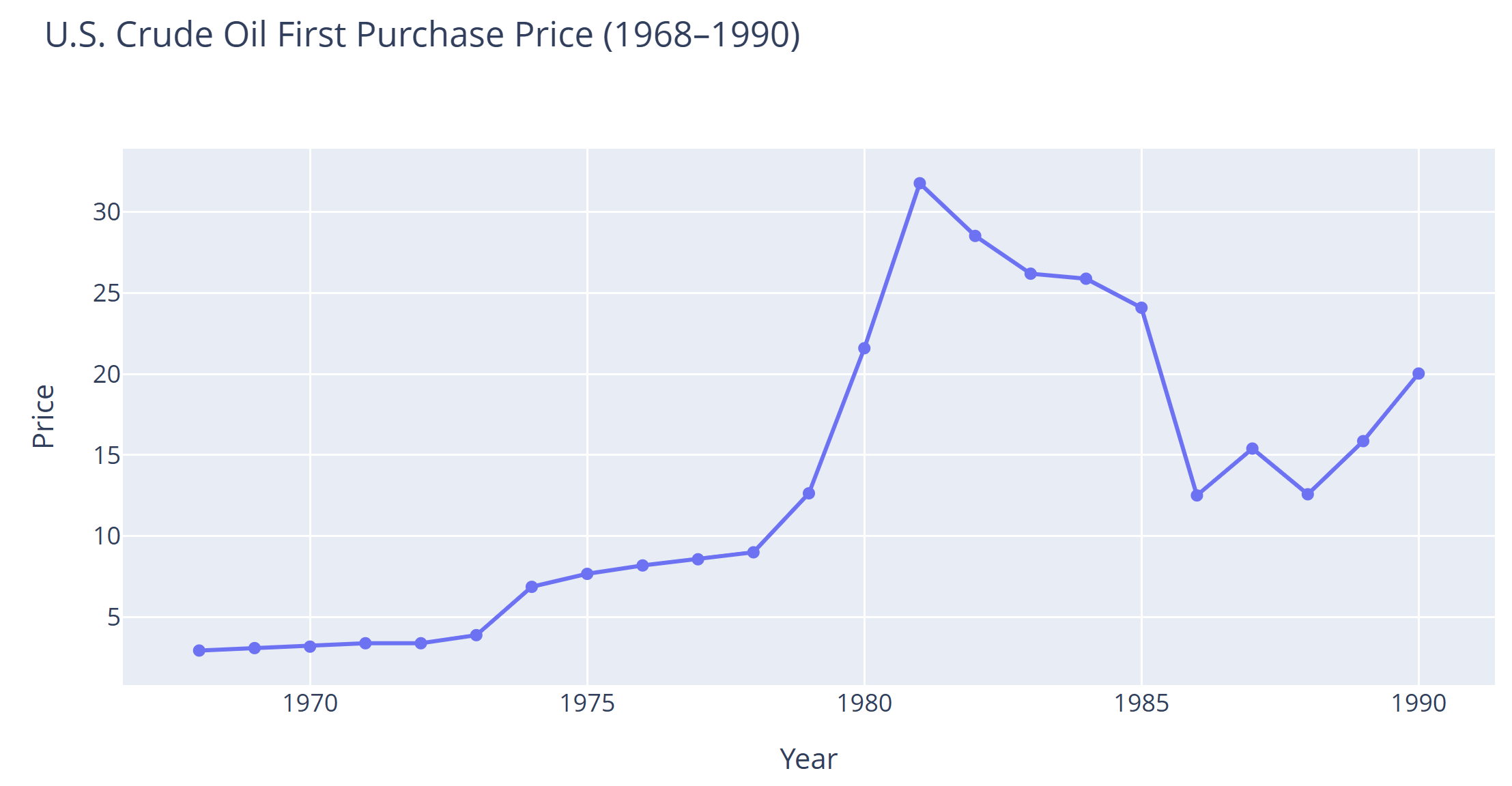
Take for example the Iranian revolution in 1979 and what it did to oil prices. You could note that oil prices never returned to the pre-revolution price, and you’d be right. To a large extent, that’s because there’s no such thing as a financial cycle, and though that statement will anger >99% of commodities (and financial cycle) twitter (X), it’s where we’re going today.
“A new scientific truth does not triumph by convincing its opponents and making them see the light, but rather because its opponents eventually die and a new generation grows up that is familiar with it.” — Max Planck
Evolutionary systems are incredibly difficult to write formal statements about, in fact, nothing has ever been proven about one mathematically (nothing meaningful has ever been said in mathematical language about one). There is however, a field of computer science dedicated to this, called approximation algorithms, and while I won’t go into that today, I’ll mention the main ideas.
Essentially, when you’re presented a problem like “is there a self-avoiding random walk that gets lucky and visits every intersection” (this means it never destoys a bunch of intersections and gets stuck by “walling itself in”), you could come up with an approximation — or a heuristic — to find a solution. An example could be to always leave an intersection via the shortest road to the next intersection, and if there were two roads the same length, you could leave by breaking the tie by choosing the one closer to north, if they were both closer to north, you could do a second tie breaker by choosing the one closer to north-east, and so on.
Indeed, there are maps that would be fully traversed (every intersection visited), but most maps would end up with the “walk” ending up stuck, and failing to visit every intersection.
Proposing a general algorithm that can solve this problem — one that always gives the rules, if they exist, for a self-avoiding walk to cover any map — has a now 26-year old bounty of 1 million USD. Nonetheless, it remains unsolved.
So why am I mentioning this? Well, in my opinion every evolutionary system is at least a self-avoiding random walk. That means civilization itself, societies, individuals (since they evolve as they learn through time), art, finance & economics, everything, is doing this “self-avoiding” behavior where it never repeats — but it can rhyme.
Suppose for example a historical event like WW2 started to repeat itself, with uncanny similarities. The mere fact we all know WW2 happened before, prevents it from evolving the way that it evolved last time. Knowledge — or memory — influences the future evolution.
So how can we use this to look at the problems in the world today? How has nature solved this?